

When it comes to signage installation, few steps are more important than the site survey. Whether you’re installing storefront signs, monument signs, channel letters, wall graphics, directional signage, or national rebranding packages, the quality of the site survey often determines whether the project runs smoothly or becomes an expensive headache.
Yet despite how critical site surveys are, many sign shops still rely on outdated workflows built around paper forms, scattered photos, spreadsheets, emails, and disconnected apps. The result is often confusion, missed details, unnecessary return trips, installation delays, and shrinking profit margins.
The reality is simple: better site surveys lead to better signage installations.
Modern sign companies are beginning to realize that site surveys are not just a necessary chore. They are one of the most important operational processes in the entire sign production workflow. A well-executed sign installation site survey improves communication between sales teams, project managers, designers, fabricators, installers, and customers. It also helps prevent costly mistakes before materials are produced or installation crews arrive on site.
And now, digital tools designed specifically for site surveys for signage installation are changing how sign shops approach the process altogether.
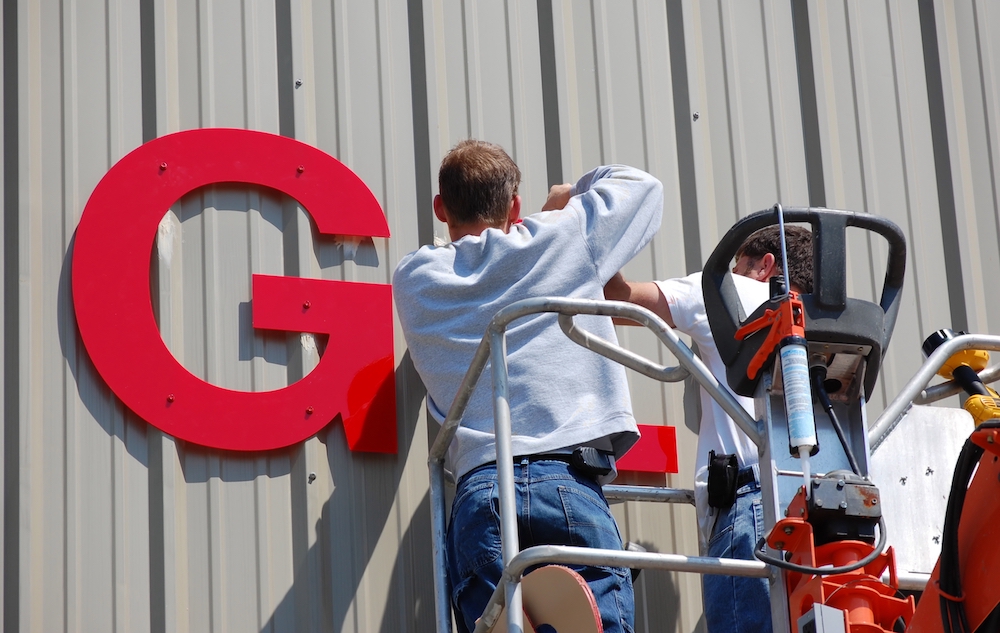
Why Site Surveys Matter in the Signage Industry
Every successful signage installation starts with accurate information gathered from the field.
A site survey for signage installation helps determine:

- Exact measurements
- Mounting conditions
- Electrical access
- Surface materials
- Visibility concerns
- Access limitations
- Local code considerations
- Installation equipment requirements
- Environmental obstacles
- Safety concerns
Without this information, sign shops are essentially guessing.
Even small mistakes during a site survey can create major downstream problems. A missing measurement could mean a fabricated sign does not fit properly. Incorrect electrical assumptions could delay installation. Poorly documented site conditions could force crews to make additional trips, increasing labor costs and frustrating customers.
According to industry professionals interviewed by Signs of the Times, poorly executed site surveys can quickly destroy profit margins and create major operational inefficiencies.
For many sign companies, especially those managing multiple installs per week, the cost of survey mistakes adds up fast:
- Additional truck rolls
- Reprints or remanufacturing
- Delayed installations
- Overtime labor
- Customer dissatisfaction
- Lost future business
- Permit complications
- Installation rescheduling
In some cases, a single missed detail can cost hundreds or even thousands of dollars.
That is why professional sign shops increasingly treat the site survey process as a core operational function rather than an afterthought.
What Most Sign Shops Still Do Today
Despite advances in technology, many signage companies still conduct site surveys using methods that have barely changed in decades.
The traditional workflow usually looks something like this:
- Handwritten notes on paper or clipboards
- Measurements entered manually into spreadsheets
- Photos stored separately on phones
- Text messages between installers and managers
- Survey forms created in Excel or Word
- Files emailed back and forth between departments
- Generic form builders like Jotform used as temporary solutions
- Notes uploaded into project management software after the fact
Even the more “modern” workflows discussed in industry publications often rely on a patchwork combination of apps and tools rather than a true end-to-end site survey solution.
Some sign shops use:
- Jotform
- Google Forms
- Notability
- GoodNotes
- CompanyCam
- Excel spreadsheets
- Dropbox folders
- Shared drives
- iPad note-taking apps
While these tools may improve certain parts of the process, they were not built specifically for sign installation site surveys.
That creates major problems.

The Biggest Problems With Traditional Site Survey Workflows
Disorganized Information
One of the most common issues with traditional site survey workflows is that information ends up scattered across multiple systems.
Photos live on phones.
Measurements live in spreadsheets.
Notes live on paper.
Project details live in emails.
Updates happen over text messages.
When teams need to reference information later, they waste valuable time hunting for details.
This disorganization becomes even worse for multi-location sign programs or enterprise rebranding projects where consistency is essential.
Inconsistent Survey Quality
Not every installer or survey technician gathers information the same way.
Without standardized workflows and required fields, critical information often gets missed. One installer may document electrical access thoroughly while another forgets entirely. One crew may take excellent reference photos while another captures only a few blurry images.
This inconsistency creates risk for project managers, production teams, and installers downstream.
No Real-Time Oversight
In many sign shops, managers do not discover missing information until after the crew has already left the site.
At that point, there are only bad options:
- Send the crew back
- Delay production
- Guess and hope for the best
Neither is good for profitability.
Manual Reporting Takes Too Long
After the survey is complete, someone still has to organize everything into a usable report.
That often means:
- Renaming photos
- Rebuilding notes
- Formatting PDFs
- Writing summaries
- Uploading files manually
What should be a simple operational process turns into hours of administrative work.
Site Survey Mistakes Are Expensive
The signage industry already operates on tight margins, especially when labor, equipment, fuel, permitting, and installation scheduling are involved.
A bad site survey can create:
- Rework
- Material waste
- Additional labor costs
- Equipment rental extensions
- Delayed customer openings
- Lost installation time
For larger projects, mistakes can become extremely expensive very quickly.
That is why more sign companies are investing in digital site survey software designed specifically for signage installation workflows.

What a Modern Signage Site Survey Process Should Look Like
A modern sign installation site survey workflow should accomplish several things at once:
Standardize the Process
Every installer and survey technician should follow the same structured workflow.
Different sign types should have different survey templates:
- Channel letters
- Monument signs
- Window graphics
- Wall murals
- ADA signage
- Directional signage
- Pole signs
- LED displays
Standardization improves consistency and reduces missed information.
Capture Everything in One Place
A modern workflow should centralize:
- Measurements
- Photos
- Notes
- Checklists
- Site maps
- Customer information
- Installation details
Instead of juggling multiple disconnected apps, teams should work from a single platform.
Allow Real-Time Visibility
Managers should be able to review survey progress while crews are still on site.
That way, missing information can be caught immediately instead of hours or days later.
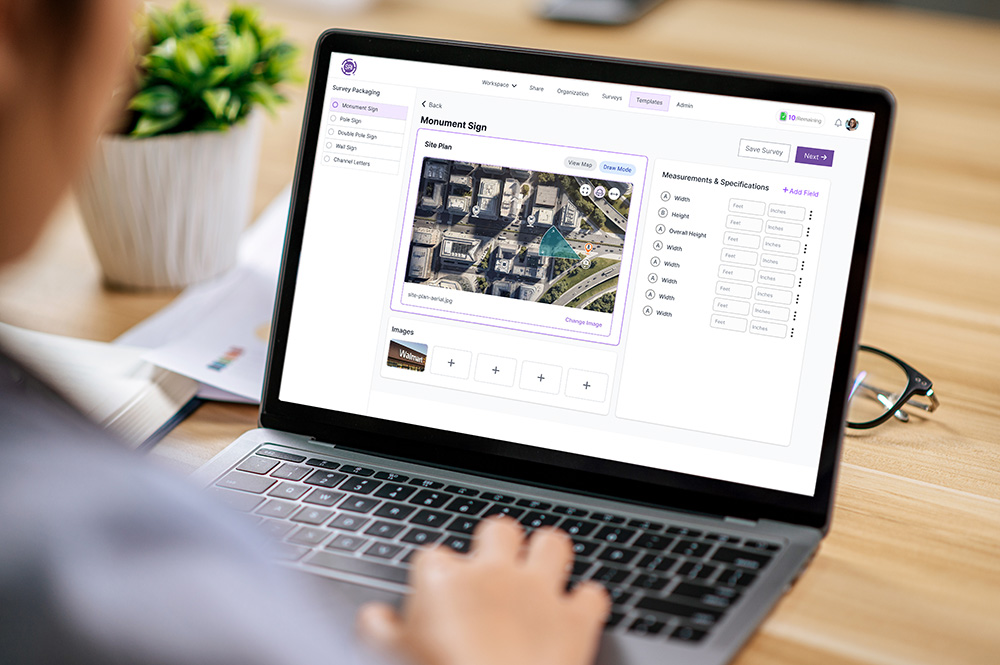
Generate Professional Reports Automatically
Survey reports should not require hours of manual assembly.
A modern workflow should automatically organize information into clear, professional documentation that can be shared internally or with customers.
Work Easily in the Field
Installers are not sitting behind desks. They are:
- On ladders
- In bucket trucks
- On construction sites
- Working outdoors
- Managing time-sensitive schedules
The software must be fast, mobile-friendly, and easy to use under real job-site conditions.
Why Generic Form Builders Are Not Enough
Some sign shops attempt to improve their workflows using tools like Jotform or Google Forms.
While these tools are better than paper alone, they still create limitations because they are not purpose-built for signage installation workflows.
Generic form builders typically lack:
- Sign-specific templates
- Installation-focused checklists
- Real-time management oversight
- Structured photo organization
- Site mapping functionality
- Workflow validation
- Team permissions
- Survey progress tracking
- Integrated reporting
In other words, they solve only part of the problem.
Signage installation workflows are unique. They require tools designed specifically around the realities of sign production and installation.
A Better Way: SAi OnSite
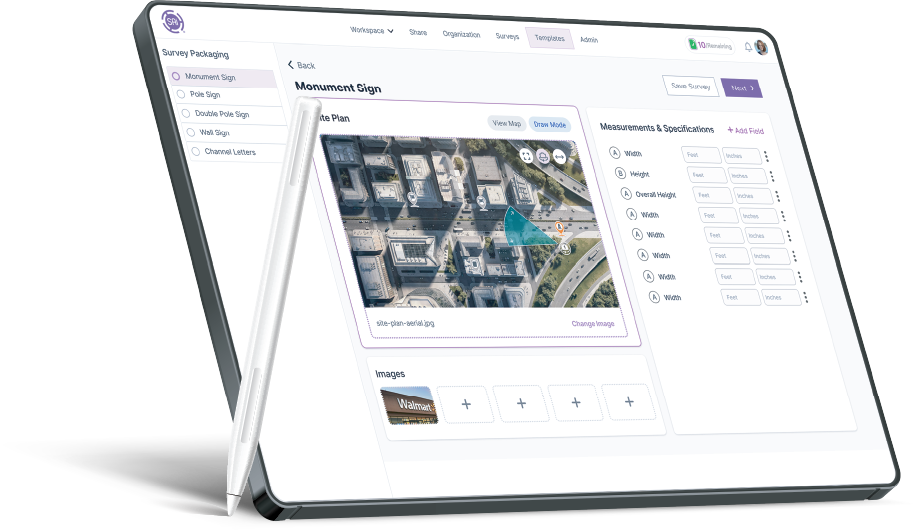
SAi OnSite was built specifically to modernize site surveys for signage installation. Instead of relying on disconnected tools, OnSite creates a centralized digital workflow designed for sign shops, installers, survey crews, and project managers.
With OnSite, sign companies can:
- Standardize survey workflows
- Capture measurements, notes, and photos digitally
- Create custom templates for different sign types
- Monitor survey progress in real time
- Generate professional reports automatically
- Improve communication between field crews and office teams
- Reduce return trips and installation errors
- Keep all survey data organized in one place
Unlike generic apps, OnSite was designed around the specific needs of sign installation teams.
Features include:
- Mobile and tablet optimization
- Site plan integration
- Real-time photo uploads
- Checklist validation
- Team and permission management
- Structured reporting workflows
For sign shop owners, the benefits are operational as much as technical.
A better site survey process means:
- Fewer mistakes
- Faster installs
- More professional customer communication
- Better internal accountability
- Reduced labor waste
- Higher profitability
It also creates a more scalable workflow for growing sign companies managing larger install volumes.
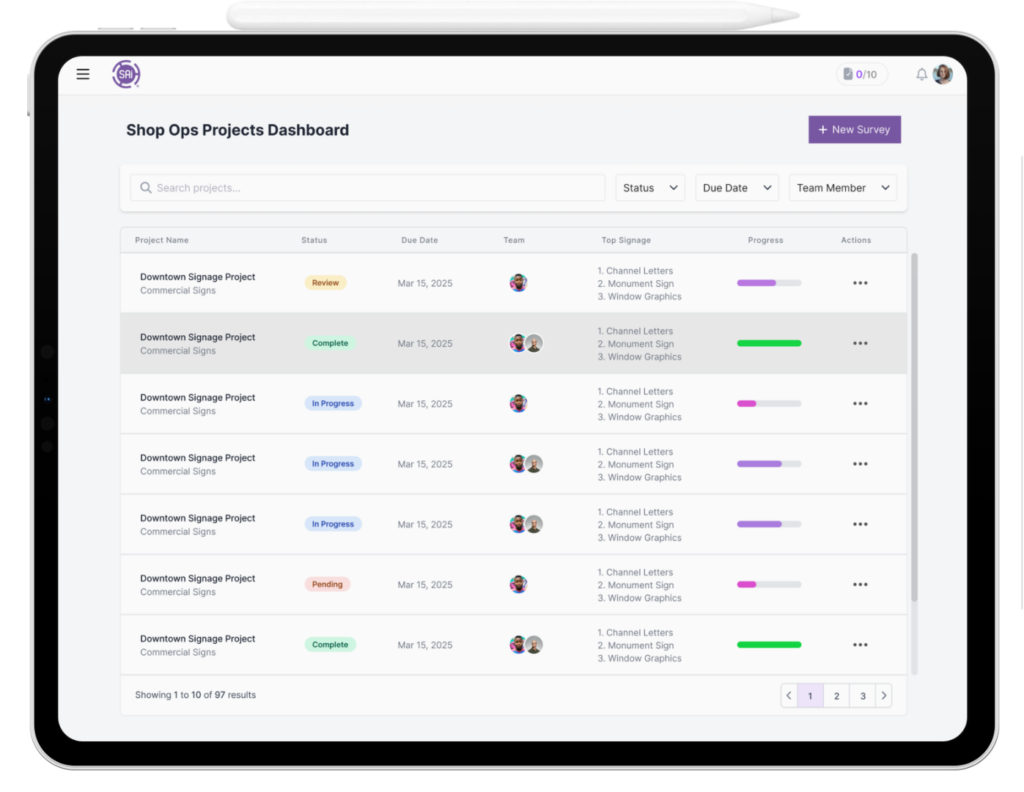
Turning Site Surveys Into a Competitive Advantage
For years, many sign companies viewed site surveys as a tedious but unavoidable part of the job.
But the shops embracing digital workflows are beginning to treat site surveys differently.
They see them as:
- A quality control process
- A profitability tool
- A customer experience advantage
- A project management improvement
- A way to scale operations more effectively
When survey information is accurate, organized, and instantly accessible, everything downstream improves:
- Design
- Production
- Permitting
- Scheduling
- Installation
- Customer communication
And in a competitive industry where timelines and margins matter, operational efficiency becomes a real differentiator.
The Future of Signage Installation Workflows
The signage industry has modernized dramatically in design, printing, routing, and production technology over the past decade.
But many sign shops are still handling site surveys the same way they did years ago.
That is changing.
As more companies move toward digital workflows, standardized processes, and real-time field collaboration, site surveys are becoming a key part of operational modernization.
The sign shops that modernize now will likely have a major advantage in:
- Efficiency
- Accuracy
- Scalability
- Customer satisfaction
- Profitability
And those advantages start before fabrication ever begins.
They start with the site survey.

Start Simplifying Your Site Surveys
If your sign shop is still relying on paper forms, spreadsheets, disconnected apps, or scattered photos, it may be time to rethink your workflow.
SAi OnSite gives sign companies a better way to manage site surveys for signage installation with a centralized, mobile-friendly workflow built specifically for the signage industry.
Whether you are a small local sign shop or a large enterprise installation team, OnSite helps reduce errors, improve communication, standardize workflows, and save valuable time.
Best of all, it is completely free to try.
Start using SAi OnSite today and see how much smoother your signage installation workflow can be.


 EN
EN  EN_IN
EN_IN  ZH
ZH